Food prices drop 53 per cent as agric sector rebounds
Nigeria’s agricultural sector is gradually rebounding, with food prices of essential commodities dropping by as much as 53 per cent, the Minister of Agriculture and Food Security, Abubakar Kyari, has
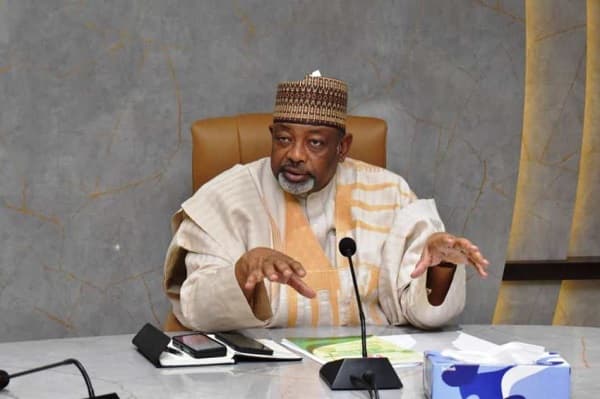
Nigeria’s agricultural sector is gradually rebounding, with food prices of essential commodities dropping by as much as 53 per cent, the Minister of Agriculture and Food Security, Abubakar Kyari, has said.
Kyari disclosed that food inflation fell to 8.98 per cent year-on-year in January this year, the first single-digit decline in a decade, signalling early gains from ongoing reforms.
Represented by his Technical Adviser on Partnerships and Collaboration, Maruf Olalekan Ajenifuye, the Minister spoke at the Vanguard Economic Discourse held in Lagos, on: “Food Security and Socioeconomic Stability: Options for Nigeria’s Agriculture Sector Rebound.”
The Minister reiterated that agriculture contributed between 23 and 24 per cent to the nation’s gross domestic product (GDP) and employs between 60per cent and 70 per cent of the labour force, making it central to economic growth and poverty reduction. He stressed that food security is critical to national stability, noting: “Food security is not just about what we eat, but how we live and ultimately how stable our nation is.”
Kyari said recent improvements follow the Federal Government’s declaration of a state of emergency on food security, describing it as “not just symbolic, but a strategic national imperative.”
However, he cautioned that the recovery remains fragile due to persistent structural challenges such as high input costs, climate shocks, infrastructure deficits and limited access to finance.
“These are not just aggregated gains; they are indicators of a system that is gradually stabilising,” he said.
Read Also: Alleged coup: Six arraigned, remanded in DSS' custody as court sets Monday for trial
He identified fertiliser as the single largest cost driver in crop production, noting that rising prices have made it unaffordable for many smallholder farmers. According to him, without intervention, yields could decline from about three to four metric tons to as low as 1.3 metric tonnes. He also highlighted the low level of mechanisation in the sector, stating that between 80 and 90 per cent of farmers rely on manual labour, over 60 per cent use animal traction, and only about three to four per cent are fully mechanised. “This limits productivity and prevents the steady production needed to reduce agricultural costs,” he said.
On financing, Kyari noted that agriculture continues to face a major funding gap, receiving less than four per cent of total financing relative to its contribution to GDP. “We still have massive deficits in agricultural financing, and the cost of accessing funds remains a major challenge,” he added.
The minister outlined ongoing government interventions aimed at stabilising the sector, including the expansion of fertiliser and input support systems and the introduction of digital farmer verification platforms to enhance transparency. He also highlighted a large-scale mechanisation programme, which he described as “the single largest mechanisation programme on the continent,” designed to enable farmers access machinery through service providers rather than ownership.
Kyari further noted that the government is shifting focus from primary production to value addition and agro-industrialisation, while also promoting climate-smart agriculture. These include the adoption of solar-powered irrigation, climate-resilient farming practices and all-year-round production systems. “We are moving from subsistence to scale and building a more resilient agricultural system,” he said.
He acknowledged the support of development partners, including the International Fund for Agricultural Development, and called for stronger collaboration to sustain the gains. Emphasising youth inclusion, he added: “When addressing the youth, we must be clear—agriculture must be positioned as a viable and profitable enterprise.”
In his address, the Minister of Livestock Development, Idi Mukhtar Maiha, emphasised the importance of treating feed and fodder development as a national priority if it is to unlock the full potential of its livestock sector,.
Speaking through his Special Adviser, Prof Eustace Iyayi, at the summit, Maiha stressed that feed accounts for about 70 percent of livestock production costs, making it the most critical constraint to growth in the sector.
“Feed is the single biggest challenge in livestock production. If we do not address it decisively, we cannot achieve meaningful transformation. Nigeria must invest in cultivated pastures, silage systems, fodder crops and structured feed markets, and integrate them into livestock value chains,” Maiha said.
He disclosed that the ministry has already begun activating a national strategy, including the establishment of fodder hubs across key livestock corridors. According to him, a pilot hub has been developed in Kwara State, with plans to expand to other regions including the Northeast, Northwest and parts of the South.
“We are working on a coordinated approach to establish fodder hubs nationwide. This will ensure year-round availability of feed and significantly improve productivity,” he said.
Maiha also raised concerns over high post-harvest losses in the agricultural sector, which he put at between 30 and 40 per cent, describing it as a major economic drain.
“We are losing a substantial portion of what we produce due to inadequate storage, weak cold chain systems, poor processing capacity and inefficient logistics. These are areas that require urgent investment,” he noted.
On financing, the minister described access to affordable credit as one of the biggest barriers facing farmers and livestock producers, warning that current interest rates make agricultural investment unviable.
“No serious agricultural business can survive on interest rates of 23 to 25 percent. It is simply not sustainable.We must create financing platforms that allow farmers to access single-digit interest loans if we are serious about food security,” Maiha said.
He called for increased financial sector participation in agriculture, particularly livestock, which he said remains underfunded despite its year-round production potential.
“Livestock production does not depend on seasons. From January to December, you can produce meat, milk and poultry. This is a sector that should naturally attract investment, yet it remains underserved,” he added.
Maiha advocated for blended finance models, agricultural insurance schemes, credit guarantees and stronger private sector participation to bridge the financing gap.
At a time when rising food prices and insecurity continue to strain households, the Nigeria and ECOWAS Representative of Food and Agriculture Organisation(FA0) , Dr Hussein Gadain warned that the agriculture sector must undergo a rapid, data-driven transformation to safeguard national stability and economic recovery.
Gadain said food security is no longer just an agricultural concern but a central pillar of macroeconomic stability, peace, and social cohesion.
“Food security is far more than an agriculture outcome; it is a pillar of national security, macroeconomic stability, social cohesion, and peace.In Nigeria, fragile food systems—affected by conflict, climate shocks, and economic pressures—translate into household vulnerability, deepening poverty, rising social tensions, and inflationary pressures in the economy,” Gadain said.
He noted that despite s vast agricultural potential, structural weaknesses continue to limit productivity and competitiveness. “With about 70 million hectares of agricultural land and 36 million hectares of arable land, the country is well positioned to drive inclusive growth through farming. Yet, agriculture contributed only about 23 per cent of GDP in real terms in the first quarter of 2025, even as more than 70 per cent of Nigerians depend on the sector for their livelihoods.”
According to him, Nigeria’s rapidly growing population—expanding at about 2.1 per cent annually—continues to increase pressure on food systems, employment, and natural resources. “The rebound of the agriculture sector is not simply a sectoral ambition; it is a national economic and social imperative,” he said.
Gadain painted a stark picture of the challenges confronting the sector, citing insecurity in farming communities, climate shocks, high production costs, and disruptions across global and domestic value chains. He added that trade imbalances further expose systemic inefficiencies, noting that between 2016 and 2019, Nigeria recorded agricultural imports of about N3.35 trillion—roughly four times higher than exports of N803 billion.
“This imbalance signals both demand pressures and missed opportunities for domestic value addition, competitiveness, and export growth,” he said, pointing out that commodities such as sesame, cashew, and cocoa dominate exports, while wheat accounts for a significant share of imports.
Despite these constraints, the FAO chief emphasised that Nigeria’s production base remains substantial. He disclosed that the country produced about 17.3 million metric tonnes of maize and 13.1 million metric tonnes of rice during the 2022/2023 season, underscoring the scale of existing output.
In the livestock sector, he said Nigeria is home to about 273.8 million animals, including 138.95 million goats, 64.93 million sheep, and 54.81 million cattle, alongside nearly 684 million poultry birds. He stressed that strengthening feed systems, animal health services, and rangeland governance would be critical to improving productivity and reducing farmer-herder conflicts.
On fisheries, Gadain noted that Nigeria consumes about 3.2 million metric tonnes of fish annually but produces only about one million metric tonnes, leaving a significant supply gap. “This gap highlights the huge potential for investment in aquaculture expansion, cold chain development, and feed systems,” he said, adding that per capita fish consumption in Nigeria remains at 11.3kg, far below the global average of 21kg.
He also highlighted cassava as a major strength, with about 14.6 million households engaged in its cultivation, but lamented the country’s limited participation in global markets due to weak processing and value addition capacity.
Gadain stressed that any meaningful agricultural transformation must prioritise smallholder farmers, who account for more than 80 per cent of producers and nearly 90 per cent of total output. “Any meaningful rebound must be designed to work for smallholders—women and men—through improved productivity, risk management, inclusive markets, and strong rural services,” he said.
Outlining a pathway to recovery, he called for increased investment in climate-smart agriculture, improved access to inputs, and expanded irrigation and mechanisation. He referenced ongoing initiatives such as resilience and land restoration programmes, which have shown measurable impact in improving yields and reducing vulnerability to climate shocks.
“Scaling climate-smart agriculture and improving access to better seeds, animal breeds, fertilizers, and water management is essential,” Gadain said. “We have seen positive results where farmers are supported with the right technologies and information.”
He further emphasised the importance of strengthening value chains to reduce post-harvest losses, which continue to erode farmer incomes and food availability. According to him, investments in storage, processing, cold chains, and rural infrastructure would not only stabilise food supply but also create jobs and reduce import dependence.
Access to finance remains another major constraint, he noted, calling for expanded credit, insurance, and digital financial services targeted at smallholders and agripreneurs. He also underscored the need for Nigeria to improve its competitiveness in high-value export markets by enforcing quality standards and scaling agro-processing.
Gadain linked food insecurity closely to conflict, revealing that between 27.2 million and 35.7 million Nigerians are projected to face acute food insecurity between 2025 and 2026, particularly in the North East, North West, and North Central regions.
“Violent conflict, kidnapping, and banditry continue to pose severe threats to food security. Addressing these challenges requires integrated solutions, including conflict-sensitive dialogue, sustainable land and water management, and strengthened local institutions,” he said.