Tragic omission
Death of quintuplet’s mother after delivery calls for more enlightenment on maternal care and safety It was an avoidable tragedy resulting from poor family planning and lack of attention to

Death of quintuplet’s mother after delivery calls for more enlightenment on maternal care and safety
- Our Reporters
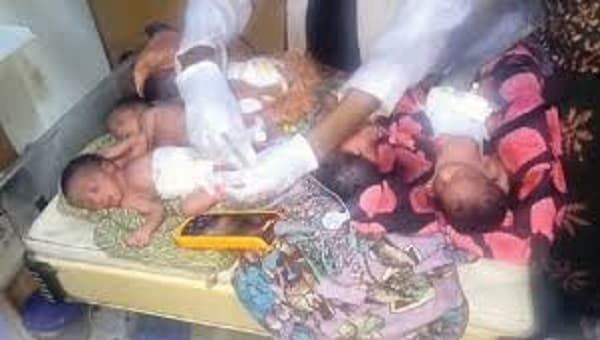
It was an avoidable tragedy resulting from poor family planning and lack of attention to reproductive health. Malam Salisu Nufi’u, a 54-year-old commercial tricycle operator in Kano State, lost his wife, Hafsatu Yusuf, 40, after she gave birth to quintuplets, three boys and two girls. The couple had nine children already before the new babies arrived.
Now, following Hafsatu’s death, her devastated husband has cried out for help. He has 14 children to take care of. “I don’t even know where to start… My biggest fear is how I will fund their feeding, healthcare, and especially their education,” he said in an interview.
Advertisement
300x250
His plea: “I am begging for help. I cannot do this alone. I need support to raise these children. They need milk, food, clothing, medical care, and education. I am calling on the government, kind-hearted individuals, and organisations to please help me. I am not asking for luxury; I am asking for survival for these children.”
According to him, the initial scan had shown “only three babies.” He was, therefore, “shocked and confused” when hospital staff told him she had given birth to three babies already and that “two more were still coming.”
“After the delivery, she started bleeding,” he narrated, adding that despite the efforts of doctors and nurses “working tirelessly to save her life… the bleeding continued. It did not stop.”
He noted that at some point before her death she told him: “I may not survive this. Please take care of our children. Make sure they go to school.” Nufi’u carries this burden with trepidation.
A critical factor in this tragedy is the statistically higher likelihood of certain complications regarding childbirth and pregnancy at age 40, often referred to medically as advanced maternal age.
It is thought-provoking that Hafsatu embraced pregnancy at age 40. It was not only a highly risky choice but also an inexplicable one, considering her history. At 40, and following 10 previous deliveries (she had lost a child), the medical risks increased exponentially.
Advertisement
300x250
This tragic case underscores the importance of family planning. It allows couples to complete their desired family size earlier in life, avoiding the high-risk “twilight” years of reproductive health where complications become more frequent.
For a family supported by a tricycle rider, the arrival of five babies simultaneously—on top of nine existing children—creates an impossible financial burden. Family planning aligns family size with available resources. This ensures that the mother is not forced to forgo essential prenatal care or hospital delivery due to cost, which often happens in large, low-income households.
Read Also: Meet Nigerian-American Ifeanyi Umunna elected as president of Harvard law student government
Indeed, family planning can be described as the first line of defence against the physiological exhaustion of the mother and the economic strangulation of the home.
In many cases, the lack of family planning is tied to a lack of awareness regarding reproductive health rights. In the context of the tragedy in Kano, these rights are the legal and social framework that could have provided a different outcome. They include: The right to information and education; the right to decide family size and spacing; the right to safe maternity services; and freedom from discrimination and coercion.
Crucially, the right to decide family size and spacing, recognised by the United Nations (UN), asserts that couples should decide “freely and responsibly” the number and spacing of their children.
“Responsibly” implies considering the health of the mother and the ability of the family to provide for the children. When a family finds it difficult to support nine children on a tricycle rider’s income, the “right” to have more children must be evaluated with a sense of responsibility. The “right” of the mother to survive must also be given serious consideration.
This tragedy is a clear signal that the authorities must intensify public education on reproductive health and the life-saving necessity of family planning.


